Custom Kitchen Cabinetry: How the Timber Millwork Division Builds It
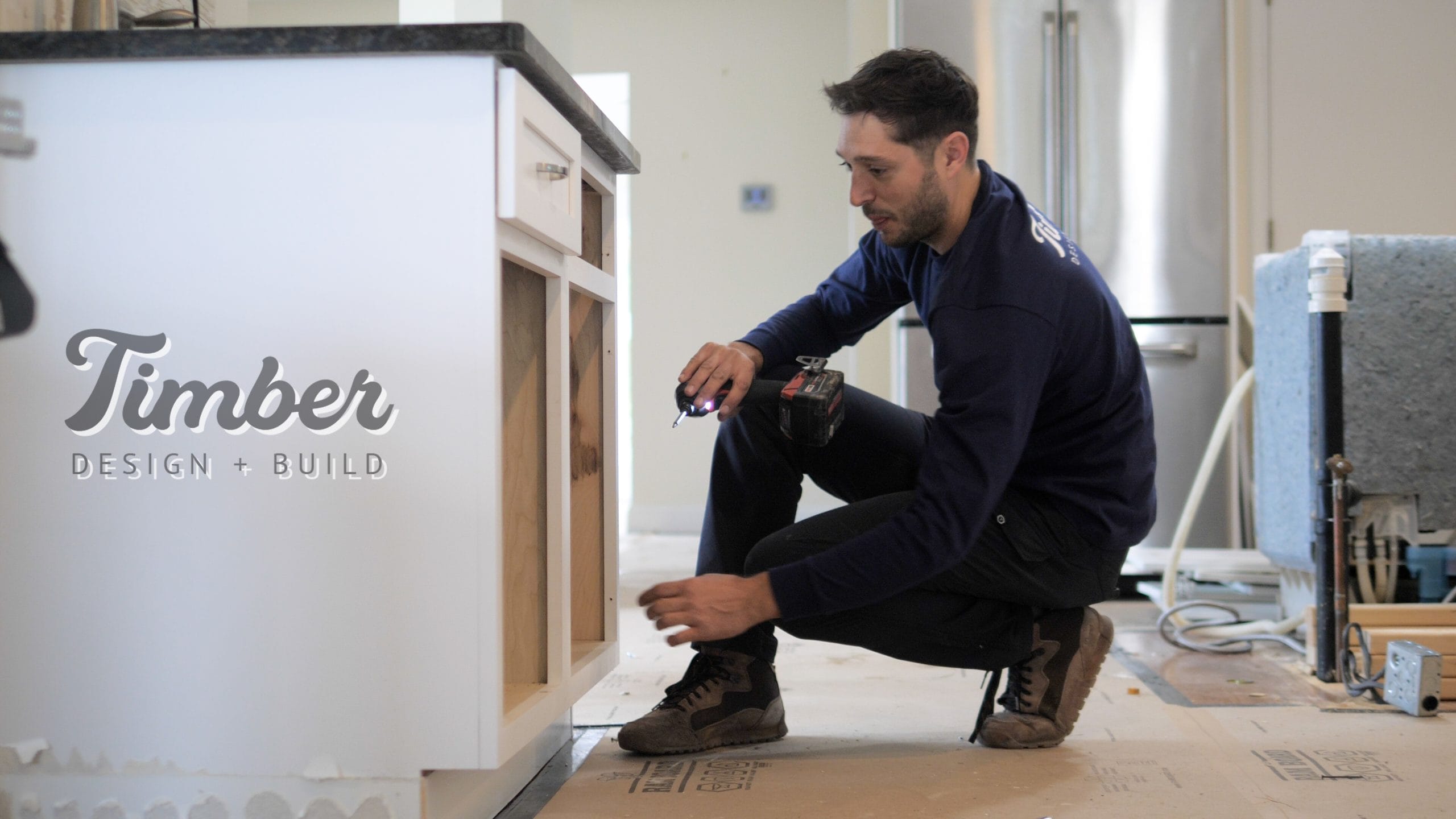
By Jeff Wiegmann, Co-Founder, Timber Design + Build
Custom Millwork — Most homeowners who specify custom cabinetry have never seen how it is made. The production process — from design drawings to finished cabinet arriving at the job site — involves a sequence of precision woodworking operations that collectively determine the quality and durability of the finished product. Understanding what happens in the shop helps you evaluate what you are buying and why the same design in custom cabinetry from an in-house shop costs more — and performs differently — than semi-custom from a manufacturer.
By Jeff Wiegmann, Licensed General Contractor, Co-Founder — Timber Design + BuildHow a Custom Cabinet Gets Made
- Shop drawings from approved design — each cabinet dimensioned precisely to its site location
- Plywood milling — cabinet box panels cut to exact dimension from 3/4" Baltic birch or hardwood plywood
- Edge banding or solid wood edge application — box edges finished to match door species
- Box assembly — dadoed joints, glued and screwed for permanent rigidity
- Door production — frame-and-panel or slab, machined for hinge cup and pull hardware
- Drawer box production — full-extension undermount slides, dovetail or box joint drawer box
- Finish application — painting or staining in finishing facility (Wallkill)
- Hardware installation — hinges, drawer slides, pulls at installation
Why Box Construction Quality Matters
The cabinet box is the structural foundation of every kitchen cabinet. Everything the cabinet does — hold weight on shelves, support drawer slides at full extension, resist the repeated stress of doors and drawers opened and closed thousands of times — depends on the box staying square, staying rigid, and staying together.
Plywood box construction is the standard for quality custom cabinetry. The Timber Millwork Division uses 3/4-inch Baltic birch plywood for all cabinet boxes — a multi-ply European birch plywood with more, thinner plies than standard domestic plywood, producing better screw-holding capacity and more dimensional stability across humidity fluctuations. Particle board boxes use larger wood particles bonded with adhesive — less moisture-resistant, lower screw-holding strength, heavier for the same thickness, and shorter service life.
Box joints: production manufacturers often use cam locks and blind dowels for rapid assembly. The Timber shop uses dadoed joints (a groove cut in the side panel that the bottom panel slides into) glued and screwed at each joint — producing a box that is mechanically connected, not just adhesive-dependent.
Door Production: The Visible Face
Ready to discuss your project?
Jeff or Chris will walk your site and give you an honest assessment. Call (845) 500-3002.
Start Your ProjectThe cabinet door is the element most people look at when they evaluate cabinetry quality. Door production involves: milling the door components to precise thickness and width, profiling the edges for the chosen door style (shaker, raised panel, flat slab, beaded inset), assembling frame-and-panel doors with mortise-and-tenon or cope-and-stick joinery, sanding all surfaces to a consistent finish-ready profile, and drilling for hinge cups at precise locations.
Inset doors — where the door sits inside the face frame rather than overlaying it — require the most precise production. The reveal (gap between the door edge and the frame) must be consistent and tight — 1/16 inch is the standard for quality inset work. This requires face frames that are precisely square and flat, and doors that are machined to exact tolerances. Production manufacturers build overlay doors almost exclusively because inset requires more skill and more time. Timber's Marlboro shop produces inset doors as a regular offering.
The Finishing Process
Finish application is done at Timber's 2,500 square foot finishing facility in Wallkill. Paint-grade cabinets receive: sanding to 150-grit, priming with a high-build primer, sanding to 220-grit, first topcoat, sanding, final topcoat. The result is a factory-quality painted finish that is more durable and more uniform than painting cabinets in place after installation.
Stain-grade cabinets receive: sanding to 180-grit, stain application by hand or spray, sealer coat, light sanding, topcoat (polyurethane, conversion varnish, or lacquer depending on the application and the client's preference for sheen level and durability). Conversion varnish is the most durable clear topcoat for kitchen applications — it cures chemically rather than by solvent evaporation and is more resistant to moisture, cleaning products, and household chemicals than standard polyurethane.
Fun fact: National Association of Home Builders data shows that properly constructed plywood cabinet boxes with hardwood dovetail drawer boxes outlast particle board cabinets by an average of 15–20 years in kitchen applications — where humidity cycling, cleaning product exposure, and repeated mechanical use stress every joint in the assembly.
Related Reading
- Custom Built Ins Vs Furniture
- Home Office Built Ins
- Custom Mudroom Design
- Built In Bookshelves Library Walls
- Back to Custom Millwork
Frequently Asked Questions
What is the difference between face-frame and frameless (European-style) cabinetry?Face-frame cabinetry has a solid wood frame (typically 1.5 inches wide) attached to the front of the cabinet box. Doors and drawers mount to this face frame. Face-frame construction is the traditional American cabinetry style. Frameless (European) cabinetry has no face frame — doors and drawers mount directly to the box sides with full-overlay hinges. Frameless provides slightly more interior access (no frame to reach around) and a cleaner, more contemporary appearance. Both styles are available from Timber's Millwork Division.
How do I specify the exact finish color for painted cabinets?We match paint colors to any Sherwin-Williams or Benjamin Moore color (our primary brands for cabinet painting), or to any paint chip you provide from any manufacturer. We also work with custom color matches if you have a specific target. All paint colors are confirmed with a sample door before production of the full cabinet set begins.
Can you match existing cabinetry in a partial kitchen renovation?Yes — matching existing cabinetry is one of the more technically demanding production tasks and one that an in-house shop handles better than a manufacturer. We require door samples from the existing cabinets to match door profile, wood species, and finish tone. The match is rarely exact (existing finishes have aged, wood species vary in grain and color), but we can achieve a close visual match that reads as intentional rather than as a patched repair.
Planning a project in the Hudson Valley?
Call (845) 500-3002 or schedule a consultation.
Start Your ProjectBy Jeff Wiegmann, Licensed General Contractor — Timber Design + Build